|
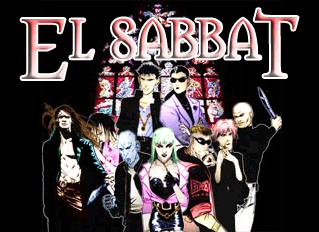
And the Sword of Cain?
War.
War against the Antediluvians. War against
Gehenna. War against the Camarilla, the Inconnu, and
the wretched Independents. War against witch-hunters,
werewolves, cowardly Anarchs, and the herds of
humanity.
This is the Sabbat.
Forged in the aftermath of the Anarch Revolt as the
Camarilla's eternal nemesis, the Sabbat is feared by
Kindred everywhere. It is a monstrous, violent sect
that has discarded any lingering trace of human
philosophy or morality. Its members exult in their
vampiric unlives.
The sect recruits wherever it gains a foothold,
spreading like a poisonous vine and tearing down the
institutions already in place. Unlike the Camarilla,
the Sabbat openly acknowledges the existence of the
Antediluvians, though only to oppose them with rabid
fury. By its own doctrine, the Antediluvians pull the
strings of the entire world, and resisting that malign
dominion is the sect's sacred cause. The Sabbat sees
the Camarilla as pawns of the Elders and, therefore,
of the Antediluvians, and fights it on both political
and physical fronts. Many Sabbat vampires speak of the
Camarilla with bilious contempt, dismissing its
members as cowards too weak to embrace their own
predatory nature.
Though it may be difficult to tell from the outside,
the Sabbat does in fact possess a codified hierarchy.
The sect has leaders and followers, commanders and
soldiers, as any other army does.
To the ignorant, Camarilla cities and Sabbat cities do
not look all that different, except for a greater
number of crimes and disappearances, and greater human
suffering with less hope of salvation.
The Sabbat is not governed so much as directed: even
the Regent and the Cardinals perform their duties out
of devotion to the cause. Even so, leadership within
the sect remains precarious.
As the home of the Camarilla's elders and the cradle of
the Sabbat, Europe is a priority battlefield in the
subtle war. Here the sect continues to struggle to
overthrow the decrepit Cainites of the Final Nights.
Unfortunately, the presence of so many enemies, as
powerful as they are paranoid, makes even besieging a
city difficult, and the Camarilla moves swiftly to
avenge any attack. As a result, the Sabbat's
influence in the region is limited, reaching mainly
into Spain and Italy, where Clan Lasombra still
retains much of its power.
In general, and bearing in mind that many of Europe's
vampires come from the Middle Ages or even earlier,
the Sabbat is forced to move slowly and cautiously if
it wishes to achieve any success. At the same time,
with both feet planted in the modern world, thanks to
the induction of many young Cainites, the sect makes
use of technology and modern institutions that lie
beyond the understanding of some anachronistic
ancients. The result is a long cold war in which the
sect sacrifices its weaker pawns in an effort to
undermine the centuries-old pillars supporting its
enemy in Europe. Since even the oldest Sabbat would
struggle to compete openly with the Camarilla's
luminaries, they must content themselves with waiting
for the inevitable shift or the fatal mistake that
will allow them to strike at a city and conquer it in
a single blow.
As already mentioned, many Sabbat of the Old World are
extremely old. Some vampires who claim to have fought
in the Anarch Revolt still advise the sect's various
nations. As a result, advancement within the sect is
painfully limited. For all its rhetoric of equality
and freedom, young Cainites in the region rarely rise
far, because older and subtler monsters still keep a
firm grip on power. Only the boldest and most lethal
schemes give a young vampire any real chance of
advancing. Thus the local packs are usually old,
entrenched brotherhoods, while the youngest often
leave after a brief apprenticeship with their sires in
search of more promising hunting grounds. In the
remote mountains and rural reaches of Eastern Europe,
small villages endure under Sabbat domination,
miniature versions of the sect's ideal.
Even among the Sabbat, European vampires often
view Americans with contempt, considering them
rude and unworthy.
As I once heard a Ductus say:
"How important can freedom be to a Cainite whose greatest moral dilemma is deciding whether to catch prey at Burger King or at McDonald's?".
|
The view from outside
The Camarilla:I have heard that Sabbat vampires drink the
blood of their packmates and burn their sires
during the rites of their so-called brotherhoods.
I have seen Sabbat cities myself, and they are among
the blackest pits of violence and despair in the modern
world. Did you know they play with snakes,
practice black magic, and even bury one another alive?
As if being a vampire were not damnation enough,
they insist on piling the Devil on top of it.
-Pantangellis, neonate of Clan Tremere.
Independents:The Sabbat are insidious. At least with the
Camarilla you know the knife is coming for your back.
Sabbat lunatics will sell you protection while they set
your haven on fire and hang your sister upside down in the
cellar. Still, never yield them an inch, because if they
come to respect you, they may decide to burn somebody else's
house instead.
-Zander, Ravnos smuggler.
|
|

About the Sabbat
The Code of Milan
By the solemn word of Regent Gorchist,
this is the one true Code of Milan, revised from the
original manuscript on this night of December 21,
1933. Born from the ashes of our great war, may it
allow peace to reign forever.
An oath of submission has been pronounced by the
Regent and the Prisci, in the presence of the leaders
of every faction and fifty other witnesses, to obey
faithfully all regulations concerning the leadership
of the Sabbat. This revised Code of Milan satisfies
all Sabbat factions, including those of the
Cardinals Huroff, Bruce de Guy, Agnes, and Carlos
VI; and the Archbishops
Beatrice, Una, Tecumseh, Thoth, Aeron, Marsilio,
Rebecca, Julian, and Salluccio. Any remaining
factions must declare their support for this revised
Code of Milan or separate themselves from the Sabbat.
|
Statutes of the Code of Milan
|
| |
|
I.
|
The Sabbat shall remain united in its support of the
Regent of the Sect. If necessary, a new Regent
shall be elected. The Regent shall support the
struggle against tyranny, guaranteeing the
freedom of the whole Sabbat.
|
|
II.
|
All Sabbat shall serve their leaders as best they can,
so long as those leaders serve the will of the
Regent.
|
|
III.
|
All Sabbat shall faithfully observe all
autoritas ritae.
|
|
IV.
|
All Sabbat shall respect words of honour freely
pledged between them.
|
|
V.
|
All Sabbat shall treat their peers with justice and
fairness, defending the strength and unity of the
Sect. If necessary, they shall provide for the
needs of their brothers and sisters.
|
|
VI.
|
All Sabbat must place the good of the Sect before
their own needs, whatever the cost.
|
|
VII.
|
Those who do not follow this code with honour shall
be considered lesser and therefore unworthy of
aid.
|
|
VIII.
|
As it always has been, so it always shall be. The
lex talionis shall remain the model of
immortal justice to which all Sabbat may appeal.
|
|
IX.
|
All Sabbat shall protect one another against the
enemies of the Sect. Personal enemies shall remain
a personal responsibility unless they endanger the
safety of the Sect.
|
|
x.
|
All members of the Sect shall defend Sabbat
territory against any outside power.
|
|
XI.
|
The spirit of liberty shall be the fundamental
principle of the Sect. All Sabbat have the right
to expect and demand freedom from their leaders.
|
|
XII.
|
The rights of Monomacy shall be used to resolve
disputes among the Sabbat.
|
|
XIII.
|
All Sabbat shall support the Black Hand.
|
| |
|
Addendum to the Code of Milan
|
| |
|
XIV.
|
All Sabbat have the right to watch over the conduct
and activities of their comrades in order to
preserve the freedom and security of the Sect.
|
|
XV.
|
All Sabbat have the right to call for counsel from
their peers and their immediate leaders.
|
|
XVI.
|
All Sabbat shall act against those who use, for
personal gain and against the interests of the
Sect, the powers and authority granted by it. Any
action taken in such matters shall proceed only
with the approval of a quorum of Prisci.
|
Forms of Address by Rank
|
Rank
|
Comparable title
|
Form of address
|
|
Regent
|
None |
Your Very Distinguished Excellency
|
|
Cardinal
|
High Lord
|
Your Eminence
|
|
Priscus
|
Grand Master, Monsignor
|
Very Reverend Sir/Madam
|
|
Archbishop
|
Archdeacon,
Father/Mother Superior
|
Your Excellency
|
|
Bishop
|
Deacon, High Father/Mother
|
Your Excellency
|
|
Templar/Paladin
|
Lady |
Lady
|
|
Ductus
|
Sir, Sergeant, Chief
|
By the Title
|
|
Priest
|
Father/Mother, Teacher
|
Reverend Sir/Madam
|
|
Pack Member
|
None |
Usually "Brother" or "Sister"
|
|
Inquisitor
|
Crusader/Judge
|
Lord Crusader/Judge
|
|
Black Hand
|
Shakar or Emissary
|
Agent "title"
|
The Law of the Sword
The Sabbat is preparing for a great war and cannot
tolerate failure in its ranks, much less betrayal. As
any army would, it protects its secrets with a
ruthless code of justice. Most punishments are
imposed by the packs themselves, but crimes truly
serious against the Sabbat are punished by the Bishop
or the Archbishop.
This is our Law:
|
CRIME
|
PUNISHMENT
|
|
Betrayal of the Sect.
|
Torture and dismemberment, in whatever poetic form
the judge decides (including falling buildings,
confinement, amputation, etc.).
|
|
Murder of another Sabbat
|
Diablerie at the hands of the victim's pack (or a pack chosen by an elder,
if the victim held office).
|
|
Deceiving Sabbat leaders
|
Burning or skinning.
|
|
Revealing Sabbat secrets to strangers
|
Death by fire or Wild Hunt.
|
|
Ignoring a leader's summons
|
Branding or mutilation (a hand is often amputated).
|
|
Striking a superior
|
Blinding or mutilation (several bones are often broken).
|
|
Association with the Camarilla
|
First offence, a warning; second, a beating; third,
impalement or death.
|
|
Failure in an important mission
|
Humiliating punishment (such as the amputation of the nose, branding
the forehead with a "P", the loss of
teeth, and the like).
|
|
Showing cowardice
|
A blood feast for the members of the
pack, though the offender is usually left alive so
they may atone for the sin.
|
|