|
The Thorn in the Heart
"The Supreme Grand Master smiled beneath his hood. This mystical business is a marvel. You tell them one lie, and when you no longer need it, you tell them another and say they are progressing in wisdom. Then, instead of laughing, they follow you even more closely, hoping to find the truth at the end of all those lies. And so, little by little, they accept the unacceptable. Astonishing..."
-Terry Pratchett
- Document written by Roselli Putanesca, member of the Giovanni clan. Destroyed in strange
circumstances in his shelter, early 2001.
How does one speak of a city whose greatest ally is also its worst enemy? Why tell the story of an urban body that can transform a thousand years of legacy in a century, and in barely a decade destroy its ancient self? Who would be foolish enough to ignore the signs and persist blindly in ambition?
Speaking of domains in Prague ought to be simple: in a thousand years of history, its few fiefdoms changed hands perhaps once every two centuries. But in less than half a century, or ten years, to be exact, Czechoslovakia, or should I say the Czech Republic, has mutated in every respect: political system, borders, regions, names, princes, usurpers, sects and allies.
Prague, of course, has been no exception. It has followed the example perfectly.

The Domains
- Document written by Roselli Putanesca, member of the Giovanni clan. Destroyed in strange
circumstances in his shelter, early 2001.
Josefov the house
of the Necromancers.
The Ghetto, Prague's old Jewish quarter, is no place for the living, nor for the unwary dead. Vassily knew that well and confined all of us "non-aligned" there. Between its Gothic synagogues, the Old-New, oldest in the city, and the Spanish, sole survivor of the Inquisition, stretches a necropolis no Giovanni could ever forget.
It all begins in the Old Jewish Cemetery: 12,000 tortured souls heaped together in a necromantic nightmare. Lucio and Adriano perished there while pursuing the legend of the Golem, that myth Rabbi Jehuda Low supposedly "gifted" to Emperor Rudolf II. When the cemetery was closed in the 15th century, the dead were buried inside the quarter, extending the necropolis into the heart of Josefov.
Vassily assigned us this hell, but it became our strength. Feuding with Setites and Ravnos defined Vassily's reign. Since 1994, after the war and two years of repositioning, we have recovered absolute control. The Setites pay tribute for their businesses; the Ravnos do not even set foot in our streets.
Josefov is the cursed quarter we never wanted, but the one that made us invincible. So long as the cemetery endures, clan Giovanni will never die in Prague.
Stare Mesto The
Old City
In only 8 km², barely 2% of Prague, one finds 1,400 historic buildings, 55,000 inhabitants and more bastards than in the rest of the city combined. Sabbat possession, Camarilla business. There is little more to say. This quarter generates more than half of Prague's annual income. Only the Giovanni and a few Lasombra antitribu have managed to wrest any business from the Camarilla.
The Nights of White Ash handed Stare Mesto to the Sword of Caine. Its siege was perfect in resources and methods for breaking the Masquerade, but useless when it came to business. They burned shops, companies and bars. Last year's floods only accelerated reconstruction. Destroying companies is pointless; one must destroy resources. It is a lesson the Sabbat still has not learned.
The Sword dominates both the Old and New Towns, forcing the Camarilla back into Hadrëany and Malá Strana. We control the northern edge; Vyshërad was left to renegade Gangrel. On the southern flank, Saint Nicholas Cathedral watches over the border with those usurious capitalists. A mysterious Lasombra appears every three months. But not everything shines for the Sword.
Internal disorder, monomacies for power, wars between Lasombra and Tzimisce against the antitribu... they are wolves that devour one another before anything else. Edgar Srotzy, the last Lasombra who tried to become bishop, died trying to convince his sect not to destroy its own gold mine. Now they do little more than defend positions while the Camarilla hides its filth behind the Masquerade.
Among its 1,400 historic buildings stand Týn Church, where archaic powers sleep, the Astronomical Clock, a Tremere spy-post, and Golz-Kinsky Palace, the gallery where Vassily used to rest when he left his castle.
Nove Mesto The
New City
This quarter, once the medieval horse market and a marketplace for other beasts as well, slaves included in its best years, has been remodelled without losing that same thread of trade and commerce. It is the natural consequence of suburbanisation, tourism and the lack of space in the old city. Museums and cultural centres matter, certainly, but Camarilla business remains stronger here than in the previous domain thanks to one of the district's two most notable sites: Saint Catherine's Church.
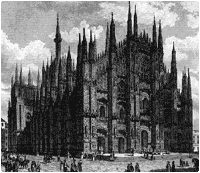 This ancient altar, its faith long since spent, is the current and public, laughable, is it not, refuge of the only Tremere chantry: a needle lost in the Sabbat haystack that causes nothing but trouble. Since the Nights of White Ash, countless packs have effectively committed suicide trying to destroy it, achieving little beyond their own disappearance. Ill tongues insist Vienna takes a special interest in preserving this public refuge, while others claim the church is nothing more than a Tremere deception meant to destabilise Sabbat control of the quarter still further.
One curious detail: the chantry's last regent, Conrad Jvarok, died during the Nights of White Ash while besieged by three packs, and took more than half his killers with him to the grave. Since then, no one knows who has taken his place. The Sabbat, of course, has not stopped its "fruitless" siege and reaps only losses. Whether the chantry possesses more Gargoyles than the Sabbat has already destroyed remains a mystery.
The Sabbat controls the approaches to the entire left bank of the city, but neither the station in Malá Strana nor the airport, some four kilometres away, lie within its domain, which means the main routes by which it might receive reinforcements remain cut off. The district's second key point is Wenceslas Square, with the Municipal Museum looming behind it. Most of its buildings date from the beginning of the century and together form one of the country's important commercial enclaves. Memorials to the victims of communism dot the area; by night it becomes one of the main gathering points for local Sabbat packs, a place many residents avoid because murders are so common nearby.
The variety of rituals and games of the Sword of Caine practiced daily in the square has allowed the accusation of satanic practices to become a political weapon under the Masquerade, increasing police pressure in the district. Even so, the officers themselves try to avoid the area. As for necromancy in New Town, we have never had any trouble beyond our raids on Saint Catherine's chantry, where we have observed the Tremere's astonishing perseverance and tenacity, and an enigmatic relic known as (...)
|
Observer Note:For reasons unknown, this is as far as the
information on the fragments found after the
disappearance of Mr. Roselli. The rest of the pages of
his personal diary, where he narrated these events, are
totally blank. It is disturbing that the paper
be old if it has never been written on, and that the
binding coincides chronologically with our
last decade.
|
Vyshërad
Refuge of the Beasts
-Document written by Mosae Ben Tecal, member of the
Gangrel clan, deserter from the Camarilla and currently of unknown whereabouts, early 1999.
This is how I tell you the story before my absence,
my childe, so that you and the whole clan may keep the tradition.
After the words of our companion Xaviar reached us by the hands of our pilgrim friends, the clan held its first referendum in the last 173 years of the city's history. For two nights, every option was discussed. In the end, nine of the fifteen Gangrel left the Camarilla. The six who remained have either died already or crossed to the Sabbat in defence of the city. We chose Vyshërad because it is the last refuge of green space in Prague, and we mean to hold it against the rapid urbanisation the city has suffered over the last decade. Our interest lies in the fact that, aside from the Romanesque castle, nearly a fortress, together with the cemetery of many Czech heroes and the two churches in the district's central area, the rest is one great green expanse known as the Dead Park for its enormous population of birches. The whole district is considered rural land, since it was once the summer palace of the Premsyls, back when it stood far enough from the city to serve as a true retreat. Now it has entered the first stages of suburban sprawl, mostly factories and industries at the city's far edge. No Kindred we know of has yet claimed the castle, though it would make a fine refuge if one wished to take advantage of its police security. I have heard rumours of a strange inhabitant there, blue-skinned and close to two and a half metres tall, but for now I take that to be unconfirmed gossip.
Despite my ignorance of Czech folklore and its legends of local spirits, which some Gangrel insist are references to lupine history, every vampire in the city knows that Vyshërad has always been a territory of beasts, and that they have never interfered in Kindred affairs. The only Gangrel who ever got on well with the lupines, one Dubcek, when he bothered to show himself among us instead of wasting years in communion with the land, could speak with them without bloodshed. He said that, despite the Crystal Dogs who dwell in Old Town or Malá Strana, the only local lupine tribes are usually Sharp Fangs or a strange tribe with powers akin to those of the selfish Lasombra.
After the referendum, Dubcek emerged once again from the
land and set out in search to present them with a
truce, so that each of us would have the
security of something known as refuge. We did not see him
leave; only his footprints remained in the mud and the
smell of the forest after the rain. We waited three tense nights,
since instinct denied us any peace. On the fourth night,
a trio of wolves came to where we were, took human form before us,
and delivered their message:
"By the wisdom of the words of your
brother Shining Claws, for the courage you have
shown and for the mark of his deeds in the
pack's memory, we have decided the following:
under Gaia's judgment, you have not earned the honor
of being called allies, but you have earned the right not to
be counted among the enemies of our
people."
The speaker, a strange stocky man whose body was
scored with scars, watched us for a few moments without words.
After a terse "May the Moon guide you,"
they left as they had come. Since then,
Vyshërad has been a refuge for Gangrel and werewolves alike,
without encounters and without trouble. We never heard from Dubcek again;
some say he returned to the dream of the earth when the war withdrew
from the hill, others that Gaia asked him to walk beyond
our borders.
The few neighbours we may have are nomadic
Ravnos or whimsical visitors, but in truth
no one has ever wanted this area, leaving us free to
roam it as we please. Several of us still
return to the city to visit old
allies or attend to other needs, but that does not mean we have
broken the truce. War, sects and
princes change their faces; the birches of
Vyshërad remain, and as they rise toward
the moon, we will call this place home.
So turn your eyes toward the city, seeking
solutions and trusting in the safety of your refuge.
With these words, my childe, I bid you farewell until
our paths meet again.
Hadrëany
Castle Town
-Intercepted report from spy Kerve Vlacek,
member of the Nosferatu antitribu clan and priest
of the Fires of the Dawn pack, missing
late 2000.
Despite successive fires and invasions, the
Castle (Prazsky Hrad) has preserved churches, halls,
chapels and towers from the Gothic splendour of
Saint Vitus Cathedral to the Renaissance additions of
Rudolf II, the last of the
Habsburgs.
From 1918 onward, the seat of the presidency was placed
in the Castle and, half a century later, Prince
Vassily, fascinated by the beauty and Baroque richness of the
palace interior, transformed it into his headquarters,
located in the eastern wing, in the area reserved
solely for the members of the government who
work there. Nobody knows how he managed to
maintain the Masquerade there, since he is already presumed dead. As
for Carlak, he fled long ago and no
current member of the Camarilla uses the palace as
Elysium anymore, though my latest investigations into his whereabouts
suggest he has gone for good, even if several
of his bastard childer still prowl the
surroundings of the Castle. Some claim that
Vassily is trapped inside one of the palace statues,
as the result of Carlak and some Tremere ally. Nothing
confirmable, for now.
The Castle is not currently under direct
Camarilla influence, but that does not mean the
district is free. The three palaces, Schwarzenberg
Palace, Lobkowitz Renaissance Palace and
Cernín Palace, were used interchangeably as
Elysium, according to whichever one the Keeper of Elysium deemed
most suitable. At present it is, above all,
a meeting point for the Ventrue and Toreador clans,
and with the city in its current state there certainly are not
many meetings, but the few that do occur are
almost always meant to plan the fate of
Prague. At the last gathering they discussed whether the
Camarilla's vampire population could bear
a renewed hierarchy grounded in Tradition,
with so many childer and neonates and so few ancillae or
elders.
The Premonstratensian complex called Strahov houses
in its underground chambers the gathering place of many
local Nosferatu, and their secrecy toward anyone,
whether of their sect or not, is extreme, at least for now.
Naturally, they continue to maintain, control and
dominate every sewer stretch within their
reach, and each night they push farther into the sewers
beneath Old Town, despite the river
cutting off many routes between the two banks. Various
war coteries, led by Brujah without
real leadership, plot action each night
against Saint Nicholas Cathedral, the Sect's spearhead
in that domain, without ever achieving any
result.
In Golden Lane, the picturesque craftsmen's houses
lined up beside the Castle's inner wall and
built centuries ago for guards and
artillerymen suffer weekly visits from a
strange group of unidentified suspected Malkavians
who, by instructing the guards at night,
influence the decisions they make by
day in the Castle's government wing. I cannot
decipher their plans, but this seems the most
worrying thing in the district: my investigations suggest the
scandal two months ago over the disappearance of
highly classified government documents was
their work. Let us remember that, although the
Camarilla's grip on police, firefighters and
other systems has been cut, those systems are not yet
fully ours either. Consequently, these Malkavians
seem determined to keep anyone from claiming that control
entirely.
In truth, most of the Camarilla population
holds out in Mala Strana, while its geopolitical
manoeuvres unfold in Hadrëany as a
distraction, a chess match played
in the shadow of the Castle walls.
Mala Strana
Vipers' Nest
The Lesser Quarter is a well-preserved area, with
too many palaces, churches and Renaissance or
Baroque buildings. It is the classic place that,
while avoiding the centre's ostentation, remains equally desirable
to the most arrogant Toreador and the most
philosophical Brujah, from the most predictable Malkavian
to the wealthiest Ventrue. That makes it
the chief reason the Camarilla is so comfortable
where it stands, and letting the enemy sleep peacefully
is never a good sign.
Kampa Island, with its statues, traps
Toreador who watch the swan flocks on the
river. In the half-hidden world at the far ends of Bridge
Street, full of picturesque gardens and
decadent squares, sewer rats traffic in
information. In Grand Priory Square, near the
mural to John Lennon, Malkavians and Brujah gather alike
to seek tentative solutions
for the city or assemble new war coteries.
The Ventrue, in their clan meetings, when they bother to hold them,
frequent the House of the Golden Unicorn, on
Lazenscka Street, where Beethoven once temporarily resided,
now a museum and cafe. These are their
usual meeting points when they have nothing better to
do, but they do not define their true domains.
Multiple apartments in the district are current refuges
for vampires; even some sewer rats
prefer flats, avoiding the
sewers. In Mala Strana Square, at the end of
Bridge Street, where most of the
embassies are concentrated, they enjoy some safety against
our phantoms posing as police officers.
Even so, its steep and narrow streets are
suspected of once having been the domain of members of the League of
Oradea, whom the Camarilla sheltered without fear.
I do not know why.
The absence of the classic Camarilla hierarchy has
made the sect's functioning, paradoxically, less anarchic than usual.
Each clan continues with its own
procedures, locked in its customary egocentrism and
selfishness, but so far there are no serious failures
of function, nor the petty political miseries that
always kept it trapped in its own bubble. Simply,
each does what it wants and or can, with that knowledge
shared beforehand only among those who must know, that is, the
Kindred involved, and no one interferes with anything, because
everyone generally works for the good of the sect,
though many continue to claim part of the
credit. Nights before his death, the previous sheriff
designed a basic security system to be followed by
ghouls, and the growing rumour of a future
Justicar helps them defend, relatively without
problems, their ground. The flank organised by
our sect already has enough to do maintaining
itself, so there is still no real possibility of
resuming our siege.
In the Smichov subdistrict, on the edge of the
neighborhood, the most luxurious part of Mala Strana, lie
the refuges of those chiefly intent on beginning to form
a principality and a
primogeniture, having established in the convention
hall of Hotel Namesti an Elysium, remember
that once the principality is formed, all the
current Elysia may quietly cease to be such;
they are only "unofficial" Elysia, according to some of the most
exacting Ventrue, open to any member of the
Camarilla. The few Tremere seen in the city
outside their refuge appear to have formed a second
chantry in that area; we do not know whether it is related
to their main Saint Catherine's chantry.
The economic domain of the area belongs to the sect,
although I have been unable to discover to whom
the funds are directed exactly. Consequently, almost
the entire economy of the city is in its
hands. At present, while we provision ourselves, as they do,
their main defense, as I already said,
is the vampires themselves, regardless of the
rest, which gives us an advantage in organisation,
though it does not eliminate the problems inherent to the
undead. I would say that, until they have a
structure fully capable of responding to our
moves, they still have time to restructure. The
Sword should exploit that margin to reform itself,
without sparing brave and valuable members
precisely in the areas where the Camarilla is lacking.
It pains me to admit it, but in that respect they surpass us.
-Semper Sabbat, Fidelis Sabbat, Eternae Sabbat.
|