|
Shadows under the Moon
Those Who Dwell on the Margins
|
The roads are full of shadows that carry no
banner. We are neither heroes nor traitors,
only the names you erased from your lists.
|
| - Anonymous |
|
|
Name:
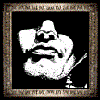
Dubcek, "Shining-Claws"
Clan:
Gangrel
Embrace Date:
Rumored 1348
Apparent Age:
Close to forty
Position:
Ancient clan veteran, without formal office among
the Blood.
|
Background:
Few chronicles accurately remember Dubcek's face
before the Embrace, but the clan's eldest insist he
was claimed on the same night the University of Prague
was founded and New Town was raised. While mortals
celebrated the future of reason and stone, he learned
to see the city as one more clearing in the forest.
Since then, he has followed the rhythm of the land:
long silences beneath the soil, in communion with the
earth, followed by brief awakenings whenever the line
of walls shifted or a new district bit into a hill.
For Prague's Gangrel, he became a mixture of legend
and reluctant counselor. For six centuries, Dubcek
never let the Beast consume him; instead, he learned
to walk beside it, like one walks beside a wolf that
is respected, never chained. Veteran of Hussite wars,
invasions, fires, and catastrophes that erased whole
districts from the map, he spoke of fronts, plague,
and besieged cities with the same calm with which he
stroked birch bark. Those who heard him say he often
repeated that Gaia does not distinguish between bombs
and fangs, only between what can return to earth and
what has forgotten it.
For the Gangrel of Central Europe, his name came to
weigh more than that of many princes. His journeys,
always traced along forest edges and old roads, put
him in contact with border wardens, scouts, and
ancillae from other domains, leaving behind a trail
of favors and warnings. When Xaviar rose as one of
the clan's strongest voices, many recalled that long
before Justicars or assemblies, it was elders like
Dubcek who taught the clan to step back from the
Ivory Tower and listen to the earth again. Wherever
Xaviar's word carries weight, many still invoke
Shining-Claws as one of the first to prove that
Gangrel loyalty belongs not to a Sect, but to the
territory they tread.
When Xaviar's call reached Prague and the clan
debated its future, Dubcek was one of those silent
voices that tipped the referendum. He did not speak
of politics, but of shelter and roots. It was he who
named Vyshërad not as domain, but as sanctuary: the
last green breath before concrete drowned the hill.
There, among the birches of the so-called Dead Park,
he found the right words to speak with the local
lupines and offer them what Kindred had forgotten how to
frame: a truce born of respect, not fear.
The packs took three nights to answer. Dubcek was
never seen again, but his words, repeated in lupine
voices, granted the Gangrel the right not to be
counted as enemies in Vyshërad. Since then, his name
is whispered among the city's Savages as that of a
strange mediator: closer to Gaia than to Princes,
friendlier to wind than to any Sect. Some say he is
still out there, watching the edge where stone bites
into forest, waiting to see which side bites harder.
Quote:
"Cities fall, and Sects change their names. The land, however, remembers every footprint we leave upon it."

|
|
Name:
"The Observer"
Clan:
Unknown (outlawed lineage)
Embrace Date:
Unknown
Apparent Age:
Unknown
Position:
Declared Anathema by Clan Tremere; author of the
Chronicle of Prague's Final Nights.
|
Background:
He did not choose the title; the city chose it for
him. For decades he appeared only as a signature at
the bottom of reports, warnings, and marginal notes
in other people's archives:
The Observer.
Childe of Aisha bint Wahiba.
Childe of Scatha-Columbkille.
Child of betrayal.
Orphan of a dying family.
He never added more, yet those five lines were enough
for certain elders to start digging through old purge
wars and bloodlines erased from the books. No one
dared speak it aloud, especially once the Tremere
began to show an excessive interest in finding him.
In life and unlife, his trade was always the same: to
watch, to listen, and to leave a record. When he
agreed to chronicle Prague's Final Nights, he did so
neither for honors nor for promises, but out of the
bitter need to repay a debt to the prison-city that
had marked him. From the outset he made it clear that
he would not write to please anyone: his purpose was
not to beautify ruin, but to dissect it with the
precision of someone who knows the price of every lie.
Where there were facts, he nailed them down; where
only rumors remained, he traced the most likely
outcome; and where deception ruled, he pointed to the
cracks and to those who profited from them. In that
way, his chronicle ceased to be mere testimony and
became a map of guilt and omission, a relentless
cartography many would rather have erased.
His relationship with Prague's mystical powers was
always ambiguous. He described, with a blend of
clinical precision and near-superstitious distrust,
how the Chapel of the Northern Cross stood upon a
geomantic web, a network of invisible lines capable
of turning its interior into a labyrinth that could
spit intruders out into any corner of the city. He
recorded names, dates, mortal architects, and
immortal builders, and hinted that the same web beats
beneath many other Prague buildings, as though the
whole city were an organism healing its wounds at its
own pace. By contrast, when he wrote of the Old Jewish
Cemetery, he was more restrained: he gave enough
detail to disturb, never enough to fully reveal what
he had seen below.
Many repeat that the lord of the cemetery was one of
the two patrons who commissioned the Chronicle from
the Observer, and that the commission formed part of
an ancient payment tied to whatever sleeps, or wakes,
beneath the Jewish gravestones and to how it is bound
to the same network that feeds the Tremere Chapel.
Whether that is true or not, it is striking how much
the chronicler wrote about the shifting corridors of
the warlocks' laboratory, and how many silences he
left when the secrets of the cemetery were concerned,
as though in this particular case part of the debt had
been paid through silence.
His Chronicle, his dealings with Sabbat childer in
search of information, and his refusal to betray
contacts or allies sealed his fate. On the night of
March 31, 2002, Clan Tremere made its sentence public:
Anathema, inclusion on the Red List, a Blood Hunt
across all its domains, and the declaration that his
remains would become a personal trophy of the Chapel
of the Northern Cross.
Officially, all that remains of him is a name to be crossed out
and a reward. Unofficially, some insist that as long
as there are childer determined to repeat the same
mistakes, someone will keep taking notes in the
shadows.
Quote:
"I am not here to flatter your ego or justify your wars. I am here only to leave a record of what you have done... and what you will have to pay for."
|