|
The Golem,
Guardian of Prague
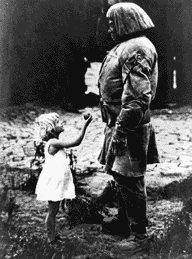
The Golem won worldwide fame through the
novel of the same name by Gustav Meyrink, the
German writer who lived in Prague for many years. In
that fantastic novel, published during the First
World War, the Golem represents the materialization
of something mysterious and ominous, a premonition
of the madness of the twentieth century in which the
devastating fury of two world wars was unleashed.
During the First World War, the myth of the
Golem became an obsession for German artists. In
1914, filmmaker Paul Wegener shot a film evoking
Prague's mysterious atmosphere and played the role
of the Golem himself.
In 1920, the filmmaker shot a new version of
the Golem. These silent films, together with two
versions of The Student of Prague, inspired by the
legend of Doctor Faust's stay in Prague, played an
important role in the evolution of expressionism.
The legend of the Golem is so evocative that,
at the beginning of the twentieth century, the
Jewish writer and reporter Egon Ervin Kisch climbed
to the attic of the Old-New Synagogue to search for
the remains of the artificial man. He found only
dust and old clutter.
The reporter also dug on the so-called Hill
of the Gallows in Prague's Zizkov district, since,
according to the legends of Eastern European Jews,
the Golem's remains had been buried there. Once
again, Egon Ervin Kisch found nothing.
At the end of the twentieth century, the myth
of the Golem seemed more alive, and more sobering,
than ever. In it we see the universal and eternal
symbol of human inquiry and creation, to which man
gives his soul and which threatens the destruction of
the species itself.

The White Lady
In this kitchen there were two ovens, two grills
small and one large, since the owners of the castle
used to offer sumptuous banquets and once a year
even prepared food for five thousand diners.
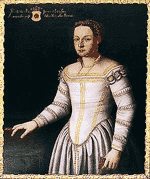
Mrs. Perchta - that was the name of the woman
who became the White Lady - married the elderly
John of Lichtenstejn at the age of twenty.
She married at her father's insistence,
dazzled by the groom's wealth. Life beside that
stingy and disagreeable husband soon became unbearable,
and Mrs. Perchta fled to the mansion of her former
admirer, Count Sternberk. When the old husband learned
what had happened, he flew into a rage,
but that fury cost him his life when he was struck down
by an apoplectic attack.
Upon receiving news of her husband's death,
Mrs. Perchta was overcome by guilt.
She sought refuge at her relatives' estate in
Jindrichuv Hradec and tried to ease that guilt through
good works. The distressed lady introduced the
custom of serving sweet porridge to the homeless and,
even after her death, once transformed into a
ghost, the White Lady made sure this
tradition endured.
The porridge was distributed on Holy Thursday,
when hundreds of people gathered at Jindrichuv
Hradec Castle. One day, after Mrs. Perchta's
death, the poor found the gates closed,
because the new owner had decided to end
the porridge distribution to save money.
The White Lady's ghost roamed the castle,
so it did not take her long to realize
that this unworthy descendant had stopped honoring
the tradition she had established.
During her lifetime she introduced the custom of offering
sweet porridge to the poor, and even after her
death, already turned into a ghost, the White Lady
ensured that this tradition was maintained. However,
the new owner of the castle decided to suppress
the distribution of porridge to save money.
When she realized this, the White Lady stormed,
furious, into the kitchen, hurling cauldrons,
crockery and whatever household objects lay within
her reach onto the floor. The maids fled in terror.
On returning from the hunt, the castle's owner,
Mr. Joaquin, tried to calm them, blaming
the strange noises they had heard in the kitchen
on a draught.
But the White Lady wanted to teach Mr.
Joaquin a lesson herself. During dinner, just as
he was about to sink his teeth into a fine roast,
a mysterious force snatched the plate from him,
and the same happened to the other guests. Doors and
windows began to slam with terrifying noise, and
Mr. Joaquin chose to flee into town. The White
Lady's ghost continued that war of nerves for several
days, until Mr. Joaquin promised he would resume
offering sweet porridge to the homeless.
In addition to ensuring the distribution of the porridge, the
White Lady also dedicated herself to other chores,
making her appearances in the castles of the
Rozmberk and other related lineages.
If the ghost haunted the hallways
of the mansions with white gloves, this predicted
a wedding or a baptism; black gloves announced
funerals.
The legend of the White Lady has undeniable
charm, but the tradition of sweet porridge in
Jindrichuv Hradec appears to have far less romantic
and noble roots. Everything suggests it was
the nobleman Adam who introduced the custom through
a clause in his 1529 will. This Czech aristocrat
worried that his subjects were giving themselves over
to excessive beer consumption, and used the porridge
distribution in hopes of steering them away from
such excesses.
It was a commendable aim, but in a brewing
country it was bound to fail. The descendants
of nobleman Adam replaced honey-sweetened porridge
with beer soups, which for a long time were a
favorite dish among the less fortunate in Bohemia.
The Porridge Festival tradition survived in Jindrichuv
Hradec until 1782. Diners were served hot beer
with a plate of peas and pearl barley.
The Church of Santiago
The Basilica of Saint James, with its three naves, is a
splendid monument of the Czech capital, located on the
Stupartska Street in Prague's Old Town. It stands out
for its exquisite decoration, due to the painters
Vaclav Vavrinec Reiner and Petr Brandl, as well as
sculptor Ferdinand Maxmilian Brokoff.
Its historic organ is renowned for its
magnificent sound. Yet within this monumental church
there is a very strange object that has left all who
enter it wide-eyed for six centuries: in a side
chapel, to the right of the main entrance, hangs an
arm. As for its origin, the following explanation can
be read in the church itself:
"In the year of grace 1400, during the pontificate
of Pope Boniface IX and the reign of Wenceslas IV, the
Virgin Mary, Mother of God, held the hand of a
thief when he was stealing jewels from his image,
devoutly venerated by believers in the temple of
Santiago, attached to the convent of the younger brothers
from San Francisco. The arm of the unworthy evildoer was
cut and to this day it is displayed hanging in the
church."
The image of Our Lady of Sorrows in Saint
James's, sculpted in the late Gothic style and once
placed near the side altar of Saint Erasmus, now
stands on the high altar.
Alchemy in Bohemia
The first alchemical theories reached
Czechia in the 14th century through visitors from
foreign universities, especially Paris and
the Italian schools. Although alchemy did not
usually appear among official university courses,
students could still encounter and study
alchemical treatises there.
One of the first Czech alchemists was the
Prague archbishop Arnost of Pardubice, who lived from
1297 to 1364. This ecclesiastical dignitary encountered
alchemy during his studies in Italian universities,
and historical sources say he pursued it with
extraordinary zeal. Paradoxically, in 1317 the Pope
issued a Bull against alchemists that forced them to
practice alchemy as a secret science for a time.
The Bull was later interpreted less rigidly,
and alchemy could again be practiced publicly.
Other Czech ecclesiastical dignitaries also
devoted themselves to alchemy. For example, the Prague
archbishop Konrad de Vechta gave himself over so fully
to transmutation experiments that even the Council
of Constance took notice of this "hobby" of his.
The first alchemical treatises written in Czechia
also come from an ecclesiastical figure: the
priest John of Tesin. One of his works was a
treatise written in Latin verse and titled "How
to proceed if we wish to obtain the philosopher's stone."
The oldest treatise written in Czech is
titled "The Righteous Path of Master Antonio of
Florence." It dates to 1412 and was written,
by all indications, by the Czech alchemist Jan of
Laz.
An important role in Czech alchemical history
was played by the so-called Faust House, in
Charles Square, surrounded by dark and eerie legends.
The house's aura of mystery has a historical basis:
the Dukes of Opava, who owned it from the mid-14th
century onward, installed an alchemical laboratory there.
From 1590 it belonged to the famous English alchemist
and mage Edward Kelley. Another high-born Bohemian
alchemist in the 15th century was Henry, the youngest
son of King George of Podebrady, who established his
laboratory in Kutna Hora in 1480.
As throughout Europe, the practice of alchemy
spread widely in Czechia during the 15th and
16th centuries. However, the period of its maximum flowering
and splendor in the Czech lands coincides with the
reign of Emperor Rudolf II, who ruled from the
year 1576 to 1611. At that time, both sages
and charlatans came to Prague, attracted by the
generosity of the monarch.
At that time, three major centres of
alchemical experimentation existed in Bohemia.
The first was Prague Castle, though many laboratories
were also found in Prague's Mala Strana district,
beside the Castle. Two additional centres of
alchemical practice lay outside the capital,
under prominent Czech aristocrats. William of
Rozmberk (1535-1592) installed laboratories mainly in
southern Bohemia - Krumlov, Trebon and Prachatice -
and another in the north, in Roudnice, where noted
alchemists of the era conducted bold experiments.
The second aristocrat passionate about alchemy
was Jan Zbynek Zajic of Hazmburk, from whom
two manuscripts have been preserved. His laboratory was
located in Budyne, north of Prague.
Emperor Rudolph II founded a kind of
scientific academy in which alchemy was the
principal discipline. This institution was headed by
the emperor's personal physician, Tadeas Hajek of
Hajek, the most prominent scientific mind of his
time in Czechia.
Hajek was a mathematician, astronomer, chemist,
botanist and man of culture, as well as an initiate
in hermetic sciences. He did not devote himself
directly to alchemical experimentation. Instead,
by imperial commission, he examined those alchemists
who sought to work under the emperor's patronage at
court. Though he denounced several fraudulent
practices, many impostors still managed to deceive him.
According to historian Balbin, about two hundred
alchemists worked in succession at Rudolph II's court,
and Balbin says one cannot describe how much gold
they consumed.
The famous astronomer Tycho de Brahe was also
drawn to alchemy. When in 1599 he accepted Emperor
Rudolph's invitation to settle in Bohemia, the emperor
ordered both an astronomical observatory and an
alchemical laboratory installed for him in the
Benatky nad Jizerou palace. Tycho de Brahe planned to
found an institute in Prague devoted to astronomy and
alchemy, but the project was never realized because
of the astronomer's premature death.
The most accomplished alchemist in Czech
alchemical history was Bavor Rodovsky of
Hustisany, who lived from 1526 to 1600. He was among
the most singular and learned of Czech alchemists. He came
from a noble family of modest means and
could not even attend university. Nevertheless,
through tenacious personal effort, Bavor
Rodovsky gained broad learning, mastered
German and Latin, and also delved deeply
into alchemical secrets. He devoted himself so
intensely to transmutation that
in 1573 he was imprisoned for debt in the Black Tower
of Prague Castle.
From 1578 onward, Bavor Rodovsky lived in Prague,
working as an alchemist in service to Emperor
Rudolph II. He left posterity four extensive
alchemical treatises written in Czech, now part
of the canon of alchemical literature.
Bavor Rodovsky did not discover the recipe for
obtaining the philosopher's stone, but unlike
many other alchemists, he left us a recipe for
preparing the water of life, aqua vitae. The
learned alchemist advised:
"If you wish to prepare a good aqua vitae, take
good brandy and the following condiments:
sage, ginger, nutmeg,
cinnamon, black pepper, wormwood, raisins, sugar, anise,
juniper and orange peel. Reduce all these ingredients
to powder, mix them with honey, and dissolve
them in the spirit. If you have no brandy, a
good Italian wine is enough. Let it rest for thirty
days in a tightly closed vessel, then distill
carefully."
Besides his enigmatic science of transmuting
lead into gold, the learned alchemist also cultivated
culinary art. The year 1591 was the most
successful in Bavor Rodovsky's life:
alongside an alchemy manual, he published through
Jiri Cerny's press his famous
"Culinaria, or Book on Various Delicacies."
Dr. Johannes Faust
Who is Faust? In popular tales,
Dr. Faust is portrayed as a man who, to
satisfy his sinful cravings, makes a pact
with the devil, displays his arts as a
sorcerer in public, and is finally dragged to
hell. Johann Wolfgang Goethe ennobled this
character, turning Faust into a symbol of
humanity's eternal and insatiable longing to unveil
the enigma of life's meaning.
Faust is a Central European figure,
associated with both German and Czech worlds.
Since the 17th century, tradition has linked
Faust to Bohemia. Chronicles claim he
was Czech, a native of Kutna Hora. When
the Hussite revolution broke out in the 15th century,
Faust is said to have emigrated to Germany and,
apparently, signed with two names: Kuttenberg,
the German name of his hometown, and Faust,
the Latin form of his Czech surname Stastny.
He stood out in two arts: necromancy and printing.
Subsequent investigations revealed the
true origin of the legend. In the 15th century there lived
in Germany the alchemist and printer Johannes Fust who
collaborated with the inventor of the printing press, Gutenberg.
Furthermore, between the years 1485 to 1540 he lived in
Germany a certain Dr. Faust. These three
historical personalities gave rise, in the
popular fantasy, to a legendary being, the doctor
Faust.
The oldest popular books about Faust,
called faustbuch - the oldest dates back to 1578 -,
refer to Faust's stay in Prague and describe
two trips by Faust through Europe. During the first,
Mephistopheles carried him through the air, transformed into
a winged horse; on the second trip, the magician traveled on
foot or riding a horse. One of the versions
refers to a prolonged stay of Faust in the
Prague imperial court.
One night, Faust flew from Prague to Erfurt, in
Germany, to take part in a party, and before the
dawn returned to the Czech metropolis. Another legend
relates that Faust published in Prague for the first time in
1506 his famous necromantic book that he used to
communicate with the infernal powers.
The legends about Faust are tied to
specific places in the Czech capital. The poet
Sebastian Hnevkovsky says that when he arrived in
Prague in 1782, market women in the
Old City told stories about Faust.
Hnevkovsky also mentions three houses where Faust
would have resided.
From the 1840s onward, tradition definitively
places Faust's residence in a palace in
Charles Square, in the New City. According to legend,
when the devil took Faust, he left a hole in the roof
that no one could seal. A student there found a
ducat on his plate each day; wanting more gold,
he signed a pact with the devil, who eventually took
him just as he had taken Dr. Faust.
All these mysterious and terrifying events
were said, according to legend, to have taken place
in the palace that still stands today. A former
colleague of ours who works in that enigmatic
building says that something spectral still hangs in
the air there.
In the eighteenth century, the House of
Faust belonged to the nobleman Mladota, who used to
show his guests an abundant collection of mechanical
devices and attempted chemical preparations there.
All of that surrounded the palace with mystery, and
the people of Prague came to place Faust's stay in
the city there.
|