The Sabbat Inquisition
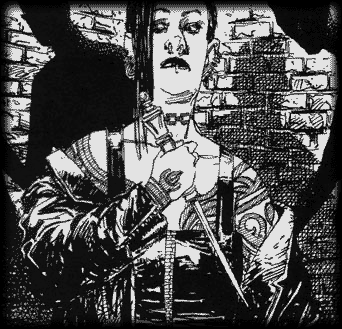 Imitating the Inquisition of Spanish mortals, the Sabbat's Inquisition is a political faction tasked with purging heretics and infernalists. It was created to combat the followers of the Path of Evil Revelations hidden within the sect and corrupting it, and in recent years it has achieved tremendous success in cities such as Detroit and Montreal, as well as among many nomadic packs. Of course, the Inquisition also recalls the mortal institution in other ways: if it accuses someone of infernalism, defending oneself is very difficult, and it has a habit of employing tactics every bit as tortuous and terrible as its historical counterpart.
The Sabbat Inquisition currently consists of around thirty members. All of them are respected and powerful Sabbat of impeccable loyalty. Groups of inquisitors travel across the sect's territories to preside over trials and carry out punishments among the accused. Despite their success in uncovering infernalists, they have earned a reputation for the cruelty of their methods. A Sabbat accused of infernalism may be branded, burned, dismembered and beaten, while one who confesses, or is found guilty, receives a slow and prolonged Final Death. Many inquisitors take pleasure in delivering these sentences, known as autos-da-fe, amputating their victims, slipping insects under the skin, or administering lashes. Nearly everyone else indulges such eccentricities rather than risk being accused in turn.
The Inquisition is also a political force, since it has the power to depose bishops, archbishops, pack leaders and ducti. Its authority is almost without precedent, because it can investigate and accuse at will. Nomadic inquisitors usually travel in groups of five, accompanied by a pair of templars. Though their successes justify the interference, they have made few friends in the rest of the organisation. Many bishops and archbishops do not welcome their presence, since they routinely interfere in the sect's normal workings to drag every Cainite's dirty laundry into the light.
When visiting a city, they question everyone, from probationary members all the way up to archbishops. Baseless accusations made by those seeking vendetta often end with the accusers themselves left exposed, ridiculed, and shamed by those they tried to frame.
Rumour holds that there is deep antagonism between the Black Hand and the Inquisition. Members of one faction are explicitly forbidden from belonging to the other, and some suspect this rivalry is the result of the inquisitors' success and recent complaints about the Hand's ineffectiveness.
After the events of the Week of Nightmares, which caused enormous losses among the Sabbat ranks, fed by the black legends that hang over Prague and the lands around it, and above all because the Inquisition itself was born on European soil, whispers have circulated for some time about infiltrated inquisitorial agents operating in secret, watching every step taken by their Sabbat brothers. The most radical claim that the diocese of Madrid has decided to send a group consisting of one Judge and two Crusaders to investigate the city and its inhabitants thoroughly for heretical practices, and to establish a stable, permanent base of operations in Prague from which to cover the whole Indo-European territory.
Many Sabbat fear for their unlives at the thought of the Inquisition descending on the area, because it promises nothing good.
Who Is Who in the Inquisition
They are the face of the organisation. They arrive in a city to examine formal charges of heresy. They operate through separate courts of three members each and, assisted by templars, place the accused before the bench. Those found guilty are subjected to unimaginable suffering and sooner or later executed in an auto de fe. Those declared innocent are allowed to continue their existence unmolested, and each receives a document called ad cautelam that proves their innocence, making it practically impossible to judge again any vampire who carries such a writ.
For a Judge, a sharp and perceptive mind matters far more than any Discipline, since they must distinguish truth from rumour and wield the fear inspired by the organisation without unbalancing the city. Occasionally there is dissent within a court over a case, but that always happens behind closed doors.
There are three pairs of them, and they operate ahead of the courts, often independently. These crusaders work in secret to uncover and hunt infernalists; their principal role is gathering information. In suitable circumstances they summon the courts to judge the heretics they discover. If anyone learns what they are truly doing, or if the prey seems likely to flee before the trial, the crusaders dispatch the suspects themselves.
The Crusaders are paired by the Chief Inquisitor, who chooses individuals with complementary skills and personalities. A typical team consists of a powerful warrior and a skilled thaumaturge assigned to a vampiric watcher, usually a retired inquisitor who remains at central headquarters managing resources.
